
From infanthood through to adulthood, we are consistently engaging in identity formation, asking ourselves the age-old question, “Who am I?” I remember playing in the dusty sand at my childhood farm, listening to the distant lowing sound of cows greeting each other. Understanding who I was and how others viewed me seemed much easier back then. My world was smaller with my family, friends, and school-mates surrounding me in a close-knit circle. When I was young, we didn’t yet have the internet or household computers, and there were no cell phones.
As our connected world has widened to where we are today, the questions about identity have become more complex as well. We interact with a wider and more diverse audience, some of whom we may never meet face to face. For many, we may look to others for their perceptions and feedback. This has a greater potential to be flawed when we have not met in person and our public face is the one that other people are using to develop an image of who we are.
For my life today as an educator, I am always aware that others may be watching my actions. For myself, I tend to live my life online in the same way that I would in person. I will post or comment on media anything that I would be willing to say in person. Generally, I have a balanced and listening approach to other viewpoints. There are many issues that I feel passionate about, but I recognize that we can all learn from each other. If I wish to share my viewpoints, I can not achieve this by disrespecting others. I am also careful about what images I share and about protecting the privacy of myself, my child, and of others. If I make any errors, I try to make amends and apologize for any lines that may have been crossed. I believe it is important to model these behaviours for our students and our children.
The complex issues surrounding digital identity go deeper than the actions, images, and words that I choose to put forth. So often, my adult students may not have the necessary digital paperwork/identification to apply for different services. Some may also be struggling to interact with the justice system. These challenges can often be time-consuming or be difficult to navigate for some, adding to the marginalization of peoples due to socio-economic factions. Masiero & Bailur (2020) discuss:
In this optic, theorising the link between digital identity and development means referring to digital identity as related to the individual’s ability of self-realisation, be this connected to the creation of livelihoods, the exercise of essential rights such as voting, or being seen by the state and competent providers as recipient of services ranging from health, education, financial services to emergency assistance and social protection.
(https://www.tandfonline.com/doi/full/10.1080/02681102.2021.1859669)
Recently, Kate-Lynn, Dalton, Rae, and Brenda shared their Team B presentation that contained an article addressing this as well. Metcalfe (2019) broke down digital identity into four categories, which were illustrated by Kate-Lynn as below:
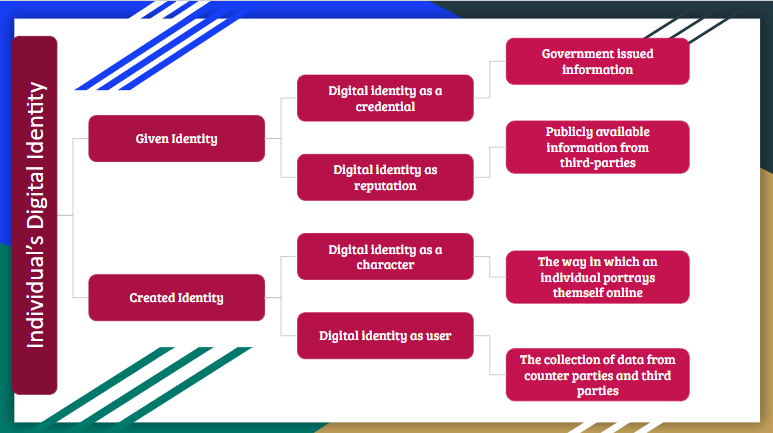
In the past, I would have thought about digital identity in a limited way with my main concern being about what I would post or share on media. I am learning that there are deeper issues and challenges for myself and others that are a part of answering the question, “Who am I?” As I move forward helping my students to learn more about digital citizenship, I can see that there is a place for a more active role. The counsellors and myself can provide active assistance and bring in outside experts to educate students on how to clear up any past financial and/or criminal records, address any online privacy concerns, and obtain digital identification needed to access government services. The issues might not be easily handled, especially as these pertain to the cyberworld where our past is discoverable, privacy is hard to maintain, and our identities have a permanent place.

Patricia, you shared your thoughts so well and raised good points. I also agree that being an educator we must be sure about what we are posting online and sharing with others. However, I feel sometimes it’s difficult to put our personal lives out on social media. And I appreciate the way you share your knowledge with others and acknowledge what others share with you.
Thank you, Gunpreesh. Like you, I am finding myself dipping my toes into new water that I was a little uncertain about at first. I am becoming more comfortable as we move along. It helps that I only share what I would feel comfortable saying to people face to face. 😀
I agree that there is a lot of difference in past and present in terms of digitalization. Even I also feel good when I get acknowledgment on my posts on social media. My question is if some digital theft occurs (Example: hacking of Facebook)what should be the first step in Canada? Whom should we can report and how hard or easy it is to get the issue resolved in Canada?
Great questions! In the case of digital theft, it depends on the type of digital theft that has occurred. Unfortunately, Facebook hacking is commonplace and the only way to report is to Facebook and to let your friends and family know. It can be very difficult to get these issues resolved. It can be like a hydra where when you chop off one head another appears. Our professor, Alec Couros, has been dealing with this for many years. His identity has been misused on many dating and other media sites.
Patricia, the skills you talk about showcasing online (listening to other viewpoints, expressing your opinions in a respectful way, apologizing when you hurt others) really stuck out to me in your post. These skills are all things that students need to see modelled and be explicitly taught about. The amount of people online nowadays who only see things from their perspective and don’t interact in respectful ways is what makes a lot of the internet drama and fighting so pervasive. I think if we teach students these netiquette skills of social interactions online, it would prevent a lot of these woes, like trolling, from happening.
Yes, these are communication skills that should be happening in-person and online. When children see these skills being modelled in an explicit manner, they will learn how to be better communicators overall. So many get caught up in online drama and treat it almost like a entertainment show to be watched, when they should be realizing it is real life and real people who are involved.
Hi Patricia, thanks for sharing the youtube link to the black mirror episode. It is so interesting how these dystopian views of the future sometimes don’t seem that wild and crazy anymore. If you were to show someone in 1980 the technology that we use regularly today their mind would probably be blown! Our technology seems to be evolving faster than ever and it can be difficult to stay caught up. You have a unique perspective with teaching adult students and that can definitely be different navigating those conversations versus with younger students. Thanks for sharing!
Thank you, Katherine. Yes, each age group has its own areas to focus on when it comes to digital literacy. In many ways, that is a good argument for developing a comprehensive digital literacy curriculum for each grade level and considering how we can build upon each successive year.
The point that stuck out most to me above all, was the age-old concept of apologizing when we hurt or offend someone online. Taking that first step to acknowledge that we have wronged someone is fundamental to learning the hows and whys of our behaviour, actions, and words and how it can be inappropriate. Without taking that first step and apologizing, we may continue that behaviour, thus continuing to hurt others. What a key concept that is so often overlooked. Thanks for the reminder.