My teaching career has spanned elementary, middle years, and senior grades. It has been a privilege to play an integral role in nurturing the strengths and leadership qualities each student brings with them. I have learnt so much and enjoyed my interactions with the families and communities in the school divisions in which I taught.
I am attaching my most recent resume. To remain succinct, I have chosen to leave off my internships in Grade 2 and Grade 2/3 split classes. However, these will always remain special memories that anchored my teaching experiences.
As a component of my Masters class on Research, I was tasked with developing a research proposal on a topic of personal interest. I am sharing a video of my research proposal, “Saskatchewan Teachers’ Perspectives on Student Mental Health.” This is a topic that is on the rise and a strong concern that deeply impacts a wide array of students of all ages and backgrounds. It is critical that we focus on readiness and supports for teachers to build self-efficacy and effectiveness, which in turn will benefit all students.
I was privileged to be able to work with an amazing team of fellow educators to craft a leadership plan for inclusive education during our Masters classes. We worked diligently to provide a thorough and considerate plan that would increase opportunities for all students. I am including the link below.
Data can be a valuable tool when used effectively to provide insight into the overall success area or improvement areas that exist for students, classrooms, or schools. Within a classroom, educators use data gathered through different types of assessment to drive their planning, set directions, and assess students’ knowledge and ability. There are key moments for gathering larger sets of data, as well. I have included a link above to a paper I wrote on this topic.
Effective educators understand the value in examining their strengths and areas for growth on a regular basis. I maintain regular review of my practices often and appreciate the reflection process. During my Masters, I was asked to complete a leadership review, which I have attached below as an example of effective practices.
I was so eager to reach the end of my Master’s classes in May 2022. It felt like I had traversed a long and arduous path. I was certain that I would be taking a mental break and resting my type-weary hands. However, I was lured back in to learning with a subtle pull. After some review, I realized that I needed only one more English literature class to apply for ELA accreditation. It was an alluring challenge, and I decided to reach once more for my notebooks and pens.
So, here I am at the precipice yet again. I am one week into my new online class that I started with Athabasca University. It is an independent course, which means I can set my own pace. I am loving it! I have been reading poetry and essays by Adrienne Rich and the writings of Virginia Woolf. Charlotte Bronte’s Jane Eyre is patiently waiting on my side table. I am inspired by the words of these authors, who encourage me to “claim” an education and seek out opportunities for growth.
Jane Eyre – (https://www.flickr.com/photos/madelinetosh/500762912)
Rich (1979) states that women need to engage in critical thinking and that to do this is “refusing to accept the givens, making connections between facts and ideas which men have left unconnected…remembering that every mind resides in a body; remaining accountable to the female bodies in which we live; constantly retesting given hypotheses against lived experience” (p. 245). This last part really spoke to me as it is the embrace of the lived experience that enriches our understanding and application of knowledge, moving away from the objective to the subjective.
She goes on to add that we need to “critique the language” by which we are surrounded, and “in breaking those silences, naming our selves, uncovering the hidden, making ourselves present, we begin to define a reality which resonates to us, which affirms our being…to begin taking charge of our lives” (p. 245).
Her words resonate harmonically with the understanding I have gained throughout my Master’s classes. Embracing the lived experiences of my students opens the doors to absent voices and new ways of knowing.
References:
Rich, A. (1979). On lies, secrets, and silence. W. W. Norton & Company, Inc.
When one plans for a journey, there are many levels of emotion, creativity, and careful consideration that go into each leg. I started out at the beginning of this course with excitement and anticipation (as discussed in my first post, Setting My Feet Upon New Paths.)
I have grown over this course in developing a deeper understanding about the importance of digital citizenship and use of media. These concepts are integral to developing students who are prepared to take on the challenges of the 21st century workplace.
It is important that our students feel like they can competently navigate the environments that exist online. They should be learning how to interact professionally and personally with others, how to apply learning skills to new tasks or tools, and how to protect privacies and rights for themselves and others.
For these reasons, I chose to develop a digital citizenship scope and sequence that also met outcomes and indicators in the Life Transitions 30 curriculum. A major resource used to support my artifact development was the Digital Citizenship in Saskatchewan Schools (2015) policy planning guide.
The purpose of Life Transitions 30 is for students to develop lifelong skills for achieving and maintaining a positive self concept and lifestyle. Throughout this course, students will learn how to adapt and grow with change, develop positive relationships, appreciate diverse perspectives, and establish habits for healthy living. They will acquire skills in effective workplace and personal communication and learn how to become aware and responsible consumers. They will build upon their understandings of the financial and personal responsibilities and obligations that come with living on one’s own.
Digital citizenship is an important component that overlays each of the content areas within Life Transitions 30. The Digital Citizenship Guide (2015) highlights, “the importance of teaching digital citizenship to our students in order to meet goals and outcomes and to prepare students to be productive, responsible, and contributing members of our global society. Educators can no longer ignore their roles in helping students to develop as digital citizens; schools must respond to the changing needs of our learners in order to prepare them for our rapidly changing world” (p. 12).
Excerpt from Patricia Ives’ Scope and Sequence
My first planning post, “Transitioning into Effective Digital Citizens,” outline the reasoning behind my choice. It also set out some possible steps for development. As often happens when we plan for travel, some steps were more challenging than others.
I searched out exemplars for other scope and sequence documents and researched potential digital citizenship online resources that would be relevant to Life Transitions 30. I quickly found that the majority of resources were geared towards elementary and middle years. There were high school digital citizenship resource that would work. However, adult resources are not as prevalent. Fortunately, I was able to locate a sufficient number of resources that would work. As I move forward, I look forward to continuing a deep dive into other possibilities. Maybe this is an unexplored avenue for future development?
I moved forward and developed a Google Form to elicit ideas from other educators on possible inclusions for each Life Transitions 30 unit. I posted this on Twitter and emailed it out to my colleagues. There were enough responses to move forward. However, the response rate was not as robust as I had hoped. I would love to hear some suggestions on how I could encourage more participation next time! Any ideas?
I proceeded down my path of discovery and created a concept map of potential ideas and possible structural formats. These led to the formation of my seemingly-endless draft documents! Over the last couple of weeks, I reached out to my fellow students, co-workers, and adult basic education colleagues to find individuals willing to share some of their time in reviewing my ideas and drafts – multiple times. I am incredibly grateful to those who provided encouragement and suggestions at this stage of development – Carolyn S., Pat P., Stacy C., Bart M., and Leah T.
Patricia Ives’ Life Transitions 30 x Digital Citizenship Scope and Sequence
LINK TO THE SCOPE AND SEQUENCE DOCUMENT:
Welcome to the end of this path. It is time to settle down in my coziest chair and enjoy the soft rainfall outside. I invite you to click on the link to view what I have created.
When I walked into this course, I had the hope that I would be able to build upon my prior experiences with the Brightspace LMS and find ways to move out of my “comfort box.” There has been a huge shift in my understanding about blended learning environments. The edges of the “box” are falling apart with the end result that I am engaging students in a wider variety of collaborative learning opportunities through rich communication strategies and outcomes-based projects. Seeing the excitement in my students’ faces and the increased levels of engagement have added value to all of the effort that I have put into developing a multi-level and diverse learning classroom environment.
When students are motivated to learn, they will be active participants who are moving into new territory. Students will move around the classroom, whether online or face to face, with renewed vigor, becoming content creators or curators for materials and other media that can be used to drive learning.
Teachers can create safe, wide-open spaces that encourage creativity and individuality where learning is driven by student interest. This is my ideal classroom that I am striving towards. My journey is heading in that direction with erasing the box and stepping out of my “comfort box.”
I invite you to explore my Summary of Learning to view my learning journey over the ECI 834 course. Thank you.
When I was considering which courses to sign up for this semester, I was drawn to learning more about digital citizenship because I felt that this was an under-explored area in my professional development. There were some limited ways that I had encouraged students to review their digital footprints in the past. My explorations have shown me that there are many rich continents of learning with new languages and diverse cultures. I feel like my eyes have been opened to the possibilities and encouraged me to continue travelling along this path. Much like Alice in Wonderland, I am amazed by all that I see and excited to discover the strange wonders that lie ahead.
Our readings over the semester have inspired me to examine my understanding of digital citizenship and deeply reflect upon how I can be be a steady guide for students as they begin to travel the new pathways. I strongly feel that educators need to actively model the actions and behaviours while also verbalizing the metacognitive processes that we should all engage in when interacting with all modes of media.
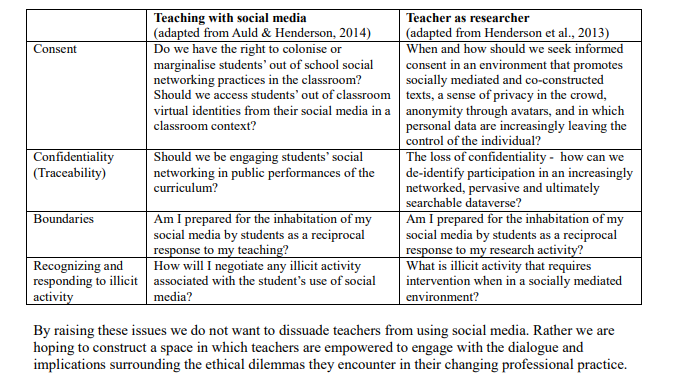
Lovepreet shared an article by Henderson, Auld, and Johnson, “The Ethics of Teaching with Social Media,” which shines a spotlight on vital considerations for all educators who are encouraging students to use social media.
Henderson, Auld, & Johnson
ECI 832 has had tremendous impact upon my current and future interactions engaging with students on digital media, teaching students how to engage respectfully and analytically with media, and exploring the embedment of digital citizenship in curriculum. For further review, I invite you to enter my exciting journey through my Summary of Learning.
Taking the initial first steps into exploring a new LMS, Canvas, I thought that I would be able to take my experiences developing content on Brightspace and transfer them to the new arena. It turned out that I was partially correct. There were some ideas that I had about what I “might” be able to do based on past knowledge, but it still took lots of exploration and watching of instructional videos to develop my modules and course to the levels that I wished to attain.
I chose to develop a course centered around Psychology 30. The curriculum had undergone some recent updates, so the materials that I developed would be useful to me in my Brightspace course. (According to some research that I have done, I should be able to export my Canvas course into my Brightspace. Hopefully, this will work!) One of the newer units for Psychology 30 is Biological Influences on Development. When I started out, I had a wider scope of modules laid out.
However, after my course was reviewed by my peers, I realized that I needed to scale back and focus on what I had initially termed to be sub-modules. These had so much content that I ended up making them modules on their own. Each module would take approximately 1.5 to 2 weeks to complete. Course Review Feedback Blog Post can be accessed via this link.
Again, I scaled in for my final course prototype and focused on fully developing the lessons within Module 1: Stress and Childhood Trauma. There are a total of six sections/lessons. Using the advice of my reviewers, I attempted to be more explicit with my instructions and outlining the steps. I added pre-requisites that would ensure students would review my Starting modules first before accessing other content. This would be something I will continue to refine. For the purposes of my final review, I did not add all of the pre-requisites that I will put in later on.
I realized that there were elements missing in my Module and lessons that needed to reflect a variety of formative and summative assessments. I added in Entrance Tickets, Review Note handouts, Google Slides/pdf to cover needed content, instructions for the Small Group Jamboard activity, and an outcomes-based Exit Review. I am happy with the variety of learning activities that I have developed. They are diverse and include active learning with movement, individual tasks, small group tasks, and active discussions. Students who would like to utilize the Closed Captioning and transcript features have been given instructions on these features during the lesson walkthrough videos. Students who are absent from class or who need review due to accommodations or for other reasons may access the lesson walkthrough videos.